SpaceX’s Louisiana Spaceport: A New Model for Southeastern Space Infrastructure
Louisiana is probably not the first state that comes to mind when you think about spaceflight. That may soon change.
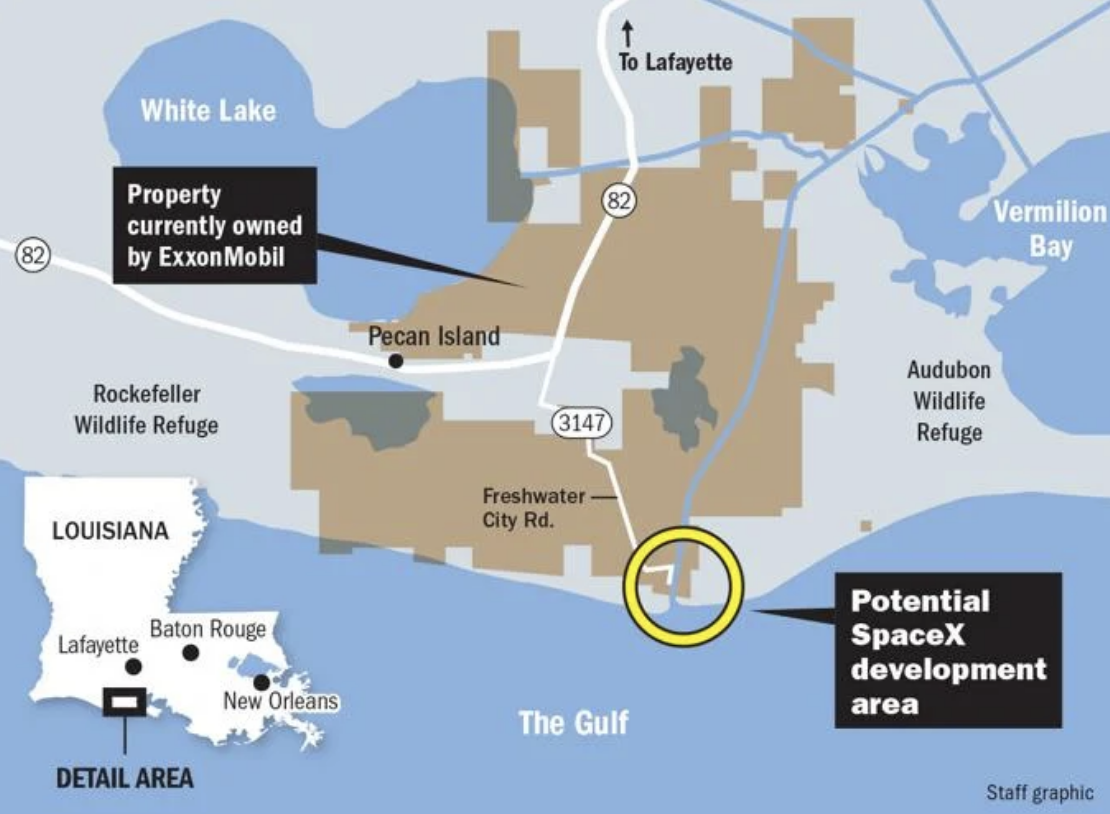
On August 25, 2026, SpaceX and Louisiana announced plans for Starbase Louisiana, a new spaceport designed to support SpaceX’s Starship launch vehicle (Louisiana Economic Development, 2026). SpaceX has pledged $100 billion for the project, which will be built on approximately 125,000 acres of land in coastal Louisiana, specifically in Pecan Island in Vermilion Parish. Elon Musk has said that Starbase Louisiana could eventually support more than 30 Starship flights per day. If those plans are realized, the spaceport would be among the largest in the world by physical footprint and launch capacity.
Construction is expected to begin in 2027, with the first launch targeted for 2029. Once completed, the spaceport will include five launch complexes with two launch pads each, for a total of ten launch pads. It will also include propellant production, power generation, vehicle processing facilities, deep-water shipping capabilities, and housing for employees and their families. SpaceX President Gwynne Shotwell described the project as a self-sustaining spaceport and said it could eventually include its own airport (Louisiana Economic Development, 2026).
The scale of the proposal is difficult to overstate. SpaceX says Starbase Louisiana will be capable of supporting thousands of launches each year and will surpass Baikonur Cosmodrome in Kazakhstan as the world’s largest launch site. The facility is intended to help the company expand Starlink, support orbital data centers, and eventually carry out missions to the Moon and Mars.
For Louisiana, the project is also an economic development opportunity. Louisiana Economic Development estimates that SpaceX will create 3,000 direct jobs over the next ten years, with an average salary of approximately $92,600—192% above the Vermilion Parish average wage. Additionally, the project is expected to create more than 8,100 indirect jobs throughout the wider region of Acadiana (Louisiana Economic Development, 2026).
How Did This Happen?
First, Louisiana had something SpaceX needed: land.
A spaceport designed to support a high launch cadence requires more than a launch pad. It needs safety zones, fuel and propellant facilities, roads, power, vehicle processing areas, and room for expansion. The former Exxon property in Pecan Island gives SpaceX access to a large, contiguous piece of land in a relatively remote part of the state. Further, its location on the Gulf Coast provides access to maritime transportation and a variety of launch trajectories. Only a few locations in the country can rival the access to both that Pecan Island boasts.
However, the property has a complicated history. For more than a decade, Louisiana parishes pursued lawsuits against ExxonMobil and other oil companies over coastal damage and land loss caused by oil and gas activity near Pecan Island. A settlement involving Exxon helped clear the way for the property to be transferred and eventually sold to SpaceX, although full terms of that settlement have not been made public (KPEL, 2026).
Second, Louisiana created a new incentive structure for aerospace projects.
The state passed Act 190 during the 2026 legislative session, creating the Aerospace Facilities and Activities Rebate. The new system allows qualifying aerospace facilities to receive rebates on state and local sales taxes for eligible purchases. To qualify, a project must invest at least $1 billion and create at least 200 new direct, permanent, full-time jobs in Louisiana.
The rebate has an initial term of 20 years, with the possibility of a ten-year renewal. It also allows the state to recapture rebates if a company fails to meet its commitments (Louisiana Legislature, 2026).
Act 190 complements the federal provisions included in HR-1, which expanded access to tax-exempt bond financing for spaceports and related facilities. Together, the two laws give spaceport developers a way to both lower their upfront financing costs and reduce the tax burden associated with construction and operations. Louisiana’s state-level incentives therefore arrived at a particularly important time, as federal policy was also making large-scale spaceport development easier to finance—an approach we recommended in our prior discussion of HR 1.
Third, Louisiana engaged its government agencies early in the process.
The Landry administration calls this approach “Louisiana Lightning Speed.” The goal is to coordinate infrastructure, workforce, permitting, environmental regulation, wildlife, and coastal protection before a project is formally announced.
Louisiana Economic Development says it will fund dedicated positions to support the agencies involved in Starbase Louisiana, including the departments responsible for transportation, environmental quality, wildlife and fisheries, conservation and energy, and coastal protection. Without those positions, the project would likely have to move through existing agencies with limited staff and competing responsibilities, creating a more fragmented and slower approval process. By adding capacity specifically for the project, Louisiana is trying to keep the review process moving without taking responsibilities away from the agencies involved (Louisiana Economic Development, 2026).
Finally, SpaceX was willing to make a significant direct investment in the surrounding community.
Under an agreement with the state and local taxing bodies, the company will pay Vermilion Parish $20 million upfront and $25 million annually for 25 years. The annual payment will increase over time through an escalator clause, and the agreement is expected to generate more than $820 million in direct local payments. SpaceX will also contribute $25 million to the Community Foundation of Acadiana (Louisiana Economic Development, 2026).
This arrangement gives Vermilion Parish a predictable source of revenue tied directly to the project. Without it, the parish would have to rely more heavily on ordinary tax collections and existing public resources to support the roads, utilities, emergency services, and other infrastructure that a project of this scale will require. The agreement does not eliminate those costs, but it gives the local government substantially more money to manage them.
However, the announcement is only the beginning of the regulatory process. SpaceX will still need to obtain FAA approvals and complete environmental, wetlands, water, wildlife, coastal, transportation, and utility reviews. While SpaceX and Louisiana have assembled and announced the project, there still is a long way to go before Starbase Louisiana becomes an operational spaceport.
What Should the Southeast Learn?
The most important lesson from Starbase Louisiana is that a successful spaceport requires a dynamic ecosystem.
Louisiana did not simply offer SpaceX a place to launch rockets. It offered the land, energy, transportation, workforce development, incentives, local revenue, political support, and agency coordination needed to build a spaceport of this scale. This total package secured SpaceX’s investment, providing a clear model for Southeastern states competing for future aerospace projects.
The region already has many of the capabilities needed to support a growing commercial space industry. Florida has major launch facilities. Alabama has expertise in propulsion and aerospace engineering. Mississippi has testing infrastructure. Louisiana has experience in energy, heavy industry, maritime logistics, and aerospace. Texas has become a center of commercial space activity. Universities and suppliers across the region provide additional research and manufacturing capabilities.
Yet it is still unclear how the region can function as a fully connected system, even when all would benefit from it. SEAS was created to address that problem. Spaceport projects across the region have historically been pursued separately, even when states and institutions are working toward similar goals. SEAS brings industry, government, and academia together around a shared strategy for Southeastern commercial spaceflight.
Starbase Louisiana shows both the value of coordination and the risks of leaving parts of the community behind. Louisiana brought state agencies, local governments, economic developers, and SpaceX together early in the process, giving the project a clearer path forward. Other states should learn from that approach, while also recognizing what Louisiana still needs to address: local participation, environmental accountability, and the risk of becoming too dependent on one company. The goal should be to build a broader regional space economy, not simply to attract one large project.
Remaining Questions
Of course, there are still important questions surrounding the new spaceport. We at SEAS have identified four that are especially relevant.
First, how firm is SpaceX’s $100 billion commitment? The figure represents a long-term investment plan, not money that has already been spent or a fully financed construction budget. This distinction matters because the project will likely be built over many years and will depend on SpaceX’s future business performance, launch demand, and ability to meet its ambitious Starship goals. Louisiana should therefore tie its incentives and public commitments to clear benchmarks for investment, construction, and job creation.
Second, how much does the project depend on Starship’s success? Starbase Louisiana is being designed around a launch vehicle that is still under development. The launch cadence described by SpaceX depends on Starship becoming reliable, rapidly reusable, commercially valuable, and fully approved by regulators. Delays or technical problems with Starship would likely delay the project or reduce the amount of infrastructure SpaceX ultimately builds. This does not make the project a bad investment, but it does mean that the project’s economic impact is tied closely to the success of a single vehicle.
Third, can Starbase Louisiana be built responsibly in Pecan Island? The project’s environmental considerations are just as important as its economic ones. Pecan Island is a fragile coastal area with wetlands, fisheries, wildlife, and migratory birds. Louisiana’s coast is already experiencing severe erosion and land loss. SpaceX has said that it will work with state and federal agencies on habitat restoration, shoreline protection, and coastal resilience. Those commitments should be evaluated based on how specific, funded, and enforceable they are. The project’s environmental benefits should not simply be assumed to offset its environmental costs.
Fourth, will Starbase Louisiana create lasting economic value for Pecan Island and the broader Acadiana region? Will Vermilion Parish businesses receive contracts, or will most of the work go to national firms? Will local residents be prepared for the project’s well-paying jobs, or will workers have to be imported from elsewhere? Will SpaceX build lasting partnerships with the University of Louisiana at Lafayette, LSU, NASA’s Michoud Assembly Facility, and local workforce organizations? And will the roads, utilities, housing, and other infrastructure support the wider community, or primarily serve SpaceX?
These questions matter because large economic development projects do not automatically create broad prosperity. Communities can prepare for a boom, invest public resources, and reorganize their economies around one company, only to be left more vulnerable when the company’s plans change or the promised growth does not materialize. Pecan Island and Acadiana should therefore seek an economic base that extends beyond SpaceX itself. The project should be judged not only by the jobs and investment it creates, but also by whether it leaves behind businesses, workers, institutions, and infrastructure that remain valuable if SpaceX’s plans change.
Moving Forward
Starbase Louisiana is a major vote of confidence in the future of commercial spaceflight. It is also a test of whether Louisiana can turn one company’s investment into a lasting regional advantage.
Louisiana has shown what is possible when land, incentives, infrastructure, and government coordination come together around a clear economic goal. The rest of the Southeast should learn from that example while avoiding its potential shortcomings. The future of Southeastern spaceflight will not be built by one state or one company alone. It will depend on whether the region can coordinate its existing capabilities and build an ecosystem that benefits communities for decades to come.