Needed Improvements
The point of this organization is to balance pragmatism and idealism for the sake of a relatively optimistic future for the region. In order to realize that future, it's vital to identify the main challenges to growth each of these sites are facing, and to solve them expediently. We have identified and outlined the four most critical challenges below, where in many cases, the solution simply depends on effective coordination.
Problem 1: Infrastructure from the 1960s is beginning to hit its limit
Relying on legacy infrastructure designed during the Apollo era has created an unquestionable operational bottleneck for modern commercial launch cadence.
Today's rapid launch schedules are pushing Cape Canaveral's 1960s physical footprint to its absolute limits, forcing range leadership to acknowledge that aging facilities cannot support next-generation demand. Through direct engagement with industry partners, SLD 45 identified five core operational gaps driven by these legacy constraints: (1) outdated utilities and infrastructure, (2) transportation access limitations, (3) constrained commodity supply chains, (4) misaligned administrative processes, and (5) a shortage of expanded launch support facilities.
To address this strain, Congress approved $1.3 billion through fiscal 2028 for the Spaceport of the Future initiative, the largest capital investment in Cape infrastructure in thirty years, alongside a 10-year, $4 billion Space Force Range Contract covering maintenance, engineering, and integration across both the Eastern and Western Ranges.
This massive financial injection follows an unprecedented surge in launch activity. The Eastern Range reached its "100 launches per year" milestone in 2025 (a benchmark originally projected for 2030), and current Space Force projections show the Cape could support as many as 500 launches annually by 2036. However, Space Launch Delta 45 Commander Col. Brian Chatman has noted that this 500-launch mark could arrive much earlier given how rapidly commercial operators are scaling. If Trump’s August Executive Order for Commercial Space is realized, it will arrive by the close of the decade.
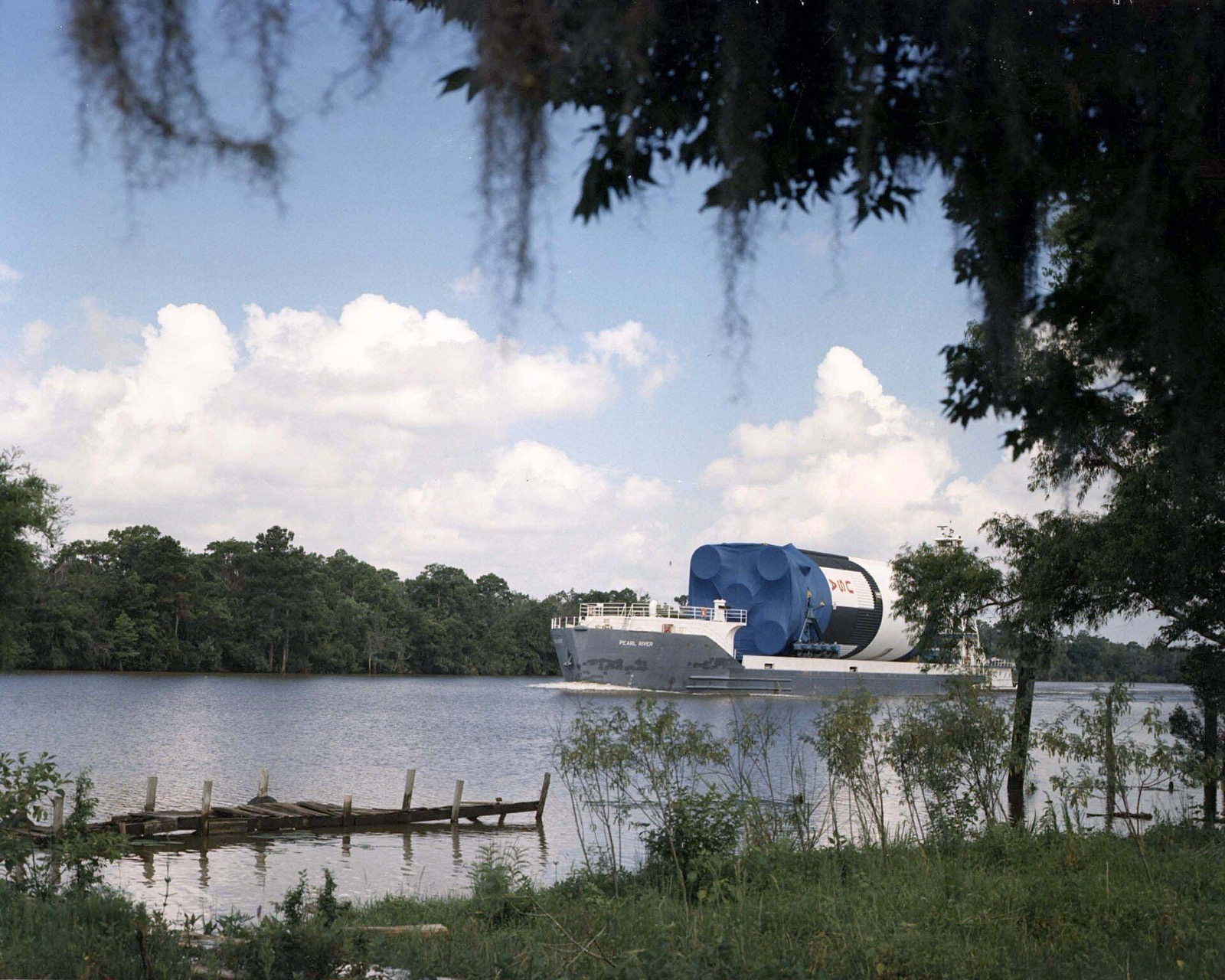
The clearest example of Apollo-era design failing modern operations is in transportation. The Cape still relies on a single main travel corridor, Samuel C. Phillips Parkway, which was engineered decades ago when launches occurred weeks or months apart rather than days. In November 2025, transporting Blue Origin’s second New Glenn booster from the wharf along the parkway to its processing facility following an ocean landing took over four hours, disrupting base traffic for an entire workday. As these operations become increasingly common, they need to integrate efficiently with all other base functions, lest logistical errors continue to compound into regular facility paralysis.
As the Cape enters what could be a decade or more of non-stop construction, it also faces a chronic staffing deficit, exacerbating the physical issues detailed above. While some of this workforce problem will surely be resolved through automation, a culture of continually missed deadlines and overruns from an insufficient workforce and bottlenecks is the largest threat to the growth that the region hopes for in the 2030s.
The clearest fix for this problem is to systematically eliminate these sources of logistical inefficiency in the Cape’s supply chain, equipping it to do more with a smaller workforce.
Problem 2: Importance and vulnerability scale proportionately
As the Eastern Range grows to accommodate the demands of a national space program increasingly concentrating its resources there, the region’s vulnerability as a single-point-of-failure increases in parallel.
By 2030, the Eastern Range is expected to host at least 300 annual launches, and perhaps many more if the Trump target of 1,000 is attained. Vandenberg will bear a similar burden in accommodating launches of polar reconnaissance satellites, leaving the two installations as the bottlenecks of nearly all military, civil, and commercial manifestations. Yet both are coastal installations, and as such, extremely exposed to both natural and low-tech physical disruptions.
For example, sea-based drone swarms have repeatedly made headlines because of how difficult it is to detect them with traditional, networked ground-based sensors. A single, wayward drone spotted near a pad can force a launch scrub, which in turn could trigger millions of dollars in cascading delays, and potentially inhibit a mission-critical payload from reaching its necessary position in orbit. And that’s assuming a benevolent actor.
Severe weather also presents an inevitable threat to concentrated coastal hubs.
Kennedy Space Center's Apollo-era facilities, including the Vehicle Assembly Building, were reportedly engineered to withstand winds of roughly 125 mph, and have only improved in their durability with iterated design. However, those ratings offer no guarantee against severe disruption. In 2004, Hurricane Frances tore more than 800 exterior panels off the VAB’s south face, halting operations for extended repairs for months.
Even when structural damage is minimal, extreme weather paralyzes operations. During Hurricane Milton, Cape Canaveral Space Force Station and KSC required nearly a week to return to normal operations. While infrastructure survived, the delays forced NASA to push back both the Europa Clipper launch and the Crew-8 splashdown recovery, neither of which were particularly time critical but still generated millions in extra costs.
Recognizing the risks associated with operational single points of failure, Congress and Space Force leadership are actively studying alternative sites like Wallops Island and Kodiak Island to ensure that a natural disaster, drone disruption, or military strike at Cape or Vandenberg can’t take the entire national space program offline.
The solution here is obvious: alternative launch and landing sites, like Wallops and Oklahoma, must receive the necessary investments to improve their infrastructure to proactively address the problem rather than face a catastrophe of underpreparedness. As global competition increases in the space domain, the theaters of that conflict become increasingly unpredictable, meaning no threat should be underestimated.
Problem 3: Recovery infrastructure has been delayed for far too long
As commercial launch cadences surge, the commercial space industry faces an unexpected physical operational constraint: dock space.
Modern reusable rockets rely heavily on sea-based recoveries, requiring specialized maritime infrastructure to haul massive first-stage boosters, payload fairings, and capsules back to shore for refurbishment and re-flight. Because next-generation boosters like SpaceX’s Falcon 9, Blue Origin’s New Glenn, and Rocket Lab’s Neutron are too wide and tall to efficiently transport across state highway or rail networks, deep waterways remain the only viable transport corridors. Furthermore, landing boosters downstream on ocean-based drone ships conserves valuable fuel, which quickly accumulates into massive savings.
This means that efficient berthing, high-load wharves, and specialized heavy-lift cranes will become as critical to reusable-launch turnarounds as the rockets themselves.
Port Canaveral has already recognized the structural capacity wall they’re facing as they gear up for more relaunch traffic than any other site. While Port Canaveral holds the unique distinction of being the only place in the world where a deepwater seaport and a spaceport are co-located, Space Florida’s 2024 Annual Operations Report and the Florida Spaceport System Maritime Intermodal Transportation Study identified the site as critically constrained from further growth without a massive rehaul of the port facilities.
The numbers behind the study are striking: recovery-and-launch ship operations are projected to climb from 197 in 2028 to 1,252 by 2073. Every recovery operation typically requires four support vessels, which will likely be supplemented through autonomous barges in the future but face an inevitable constraint in berthing capacity against exponentially increasing volume. Even worse, those space recovery fleets will actively compete for limited berths against Port Canaveral's lucrative cruise ship industry and an active naval submarine presence, neither of which can readily transition to other ports.
Port Canaveral, however, has the economic resources to expand into nearby regional waterways for redundancy, and plans to do precisely that. The draft master plan for the new Port of Fort Pierce (one of Florida’s 16 deepwater ports, ~90 miles from Port Canaveral) now explicitly features a dedicated Launch Vehicle Recovery Facility, featuring a 700-foot high-load reinforced wharf and a heavy-duty apron up to 100 feet wide, both sized to fit mobile harbor cranes, recovered boosters, and drone ships.
While this plan is still in the public review phase with neither a clear timeline nor dollar figure, construction of the VRF will plausibly take between 3 to 5 years and cost somewhere around $50 million. Because the facility is intended to relieve overflow pressure for commercial operators, the final financial model will likely involve a public-private partnership where SpaceX, Blue Origin, and/or ULA contribute capital or commit to long-term lease agreements to service the construction debt—exactly as promoted under the new H.R. 1 statute.
The completion of that project would be a landmark case study in spaceports reworking their footprint beyond their leases to improve the efficiency of their network, and how the public responds. Wallops Island would be the most direct beneficiary of a successful precedent here given their concurrent need to dredge a deep-water channel and construct a recovery port. Given the already tenuous relationship between developers at Wallops and local conservationists, that process would likely face substantially more environmental pushback than Fort Pierce, but it's inevitable if the facility ever wants to accommodate reusable vehicles.
Problem 4: Interoperability
When state legislators evaluate investments for commercial airports or deepwater seaports, they place them in the category of generic public infrastructure. This means that any provider’s vehicle can land, refuel, and take off from the site without issue, as long as they’re cleared by the proper authority.
For a variety of reasons, spaceports don’t fall into this category. Despite their access to the same funding resources and tax breaks that generic public infrastructure would receive, spaceports are under no obligation to be generally accessible to the public. In fact, spaceports are generally heavily restricted, and in the case of SpaceX and Blue Origin’s dedicated sites, they are designed to be only accessible to one provider.
Even in a world of regular port-to-port space travel, it's highly unlikely that spaceports will reach the levels of public access seen out of other transportation hubs within the century, simply given the necessary disparateness of facilities and risk regime attached to hosting passengers there. Therefore, to make any progress on this front, port-to-port interoperability needs to be prioritized. That means launch facilities and the operational infrastructure supporting them have to be able to support diverse launch vehicles, payload classes, and mission operators across commercial, civil, and defense, without needing to constantly re-fit their systems to accommodate them.
Today, true interoperability exists only on the safety and air traffic side, while physical launch hardware, pad infrastructure, and ground systems remain heavily specialized to single tenants. This approach can be disastrous for regional spaceports tailored to a single tenant, where costly, proprietary facilities are rendered useless if their sole provider shifts direction or goes under.
While this interoperability issue is broadly a question of hardware, the recent implementation of widely-adopted systems for standardized flight safety protocols and airspace deconfliction shows how beneficial interoperability could be for the region.
Traditionally, rocket flight safety relied on human Range Safety Officers (RSOs) tracking the vehicle from the ground using radar, optical tracking, and telemetry networks. If a rocket veered off course or posed a threat to populated areas, the RSO manually sent a radio command to destroy the vehicle. Between launches, safety crews spent hours manually aligning, calibrating, and configuring all ground transmitters, radars, and clearance zones to support the next flight's specific trajectory. This extensive turnaround time created long deconfliction windows, making back-to-back launches on the same day virtually impossible.
Autonomous Flight Safety Systems (AFSS) resolve this issue using onboard self-destruct systems that trigger automatically upon detecting anomalies, first tested in 2000 and first used operationally in 2017 by SpaceX. Now the industry standard for commercial and Space Force launches, AFSS removes the need for ground-based radar tracking and command-destruct transmitters, eliminating hours of instrumental recalibration between launches and theoretically allowing multiple launches from the Eastern Range in the same day for the first time.
But what further advancements can be made towards interoperability without homogenizing the industry?
Rockets are structurally diverse, varying widely in propellant chemistry, vehicle diameter, hardpoints, and umbilical ports. Because there is no standard rocket “chassis”, building a pad that can fit a large variety of vehicles requires separating the vehicle-specific hardware from the permanent pad foundation.
NASA’s best-attempt at solving this problem is the so-called “clean pad,” which is currently in use at LC-39B and 39C at Kennedy Space Center. Each of these pads uses a solid concrete foundation without attaching any vehicle-specific servicing towers, relying on mobile platforms or transporter-erectors to bring the rocket body and necessary equipment to the pad before launch. By only hosting lightning towers, propellant lines, and water sound-suppression trenches, these pads theoretically allow for a large variety of customers to make use of them, even if not currently done so on a regular basis.
Yet despite the success of these “clean pads”, there's a major difference between stripped infrastructure and truly interoperable architecture. While by no means sustaining launch at the same rate as Kennedy or Cape Canaveral, China’s Wenchang Spaceport in Hainan was designed with universality in mind, using flexible umbilical ports and varying-diameter hold-downs to accommodate “up to 20” different medium-lift commercial rocket bodies, lowering both operational cost and latency.
Ground-level hardware interoperability is by no means the convention across operational U.S. launch complexes, and it won’t start to fully produce value across the spaceport network until its widespread use. So long as relaunchable rockets remain solely accessible to a few providers, interoperability is more of a tactical hedge than an efficiency boost. Without sufficient traffic at sites beyond the dedicated pads of major providers, there’s no reason to invest in renovation, but inter-spaceport traffic requires either more launchpads or more interoperability.
Three core technical barriers prevent the latter.
First, supply chains still rely on provider-specific tanker trucks for commodity delivery rather than shared, centralized pipeline networks for industrial gases and liquid fuels. Whereas commercial airports rely on permanent underground pipeline networks to deliver jet fuel continuously to shared gates, spaceports lack these systems due to the infeasibility of maintaining massive underground networks for extreme cryogens like liquid oxygen, hydrogen, and methane. Yet a system that sometimes demands hundreds of individual tanker truck deliveries hinders high-cadence, multi-user operations, as launch delays can quickly paralyze entire facilities with traffic jams.
Realistically, spaceports should adopt a hybrid approach to address this problem: building shared underground pipeline networks for non-cryogenic ambient gases like helium and nitrogen, while constructing centralized, high-capacity bulk storage hubs near pad clusters to serve liquid propellants through short, above-ground insulated transfers.
Second, launch vehicles rely on incompatible propellant chemistries. Different propellants like kerolox, hydrolox, and modern methalox (mixtures of the cryogens mentioned above) each demand separate, specialized plumbing, and each also has different combustion rates. To account for the latter issue, the Space Force maintains a conservative 100% TNT blast-equivalency rating for propellants pending extensive testing, dictating massive safety buffer zones for vehicles that use methalox. Starship uses 11 million pounds of it per launch, meaning that there must be a safety zone around any Starship launch equivalent to the buffer that would be appropriate for 11 million pounds of TNT.
This problem is partially solved by ensuring that propellants are fully tested and standardized prior to deployment to reduce these worst-case scenario buffer zones. Most empirical data suggests that actual blast yields fall closer to 10 to 20 percent of the full TNT equivalent, and industry has pushed for a standard at or below 25 percent. Updating official safety manuals with more accurate estimates would result in better organization of sites by respective propellant chemistry.
That isn’t to say that propellant chemistry needs to dictate pad capability, as that problem can be solved with more modular propellant storage systems. Currently, launch sites require providers to build entirely new tank farms when using a new mixture that requires different containment. SpaceX has had to build permanent lines for both kerolox and methalox at LC-39A, while other providers are expected to provide the fueling systems with the mobile launchers.
Modular infrastructure poses a natural solution to this problem. Instead of permanently building custom pipelines beneath a launch mount for every new vehicle, spaceports should be routing generic cryogenic trunk lines to standardized utility vaults, which ground crews can temporarily fit with swappable containerized fuel modules.
Third, that same issue carries through to Ground Support Equipment, encompassing all the mechanical, fluid, and electrical infrastructure connecting it to the infrastructure. Because aerospace companies build their launch vehicles in isolation, there are no industry-wide hardware standards to follow, leading to massive variation in GSE.
Modern launch pads feature steel hold-down arms, swinging umbilical towers, and quick-disconnect fluid fittings that are engineered down to the millimeter for a single rocket's structural frame. Furthermore, every rocket operator broadcasts flight health data, guidance instructions, and command signals over distinct, proprietary radio frequency bands. Although much progress has been made in making data networks integrate more seamlessly via AFSS, it still takes months of physical overhaul to change GSE between providers.
A stark real-world example of this fragility is Pad 0A at Wallops Island. Pad 0A was originally built in partnership with Orbital Sciences (which later became Orbital ATK, then Northrop Grumman) and was tailored specifically to the Antares rocket. This meant that all GSE was engineered exclusively for Antares’ unique physical footprint, with no mechanism to quickly re-outfit it.
The inherent vulnerability of this single-tenant approach was brutally realized in October 2014, when an Antares rocket suffered a catastrophic engine failure seconds after liftoff, destroying the vehicle and severely damaging the pad. Because the facility was bespoke to Antares, MARS could not simply lease the pad to another rocket provider to keep revenue flowing while Antares was grounded. Instead, the state-backed asset sat idle for two years, absorbing zero launch revenue while requiring over $15 million in state and federal funds to repair the blast damage and retrofit the pad as Antares went through subsequent redesigns.
To realistically solve this problem without forcing aerospace companies to abandon their proprietary rocket designs, spaceports must eventually adopt standardized, modular pad interfaces rather than building monolithic, single-tenant structures.
Under this architecture, the permanent ground infrastructure would terminate at a universal utility vault containing standardized connections for power, data, and fluid lines. Individual launch providers would then supply their own transportable, vehicle-specific umbilical arms and hold-down adapter plates that bolt directly onto the universal interface, which the spaceport authority could then swap out in days or weeks, rather than spending months on demolition and re-construction.
Proof-of-concepts for this model already exist outside the U.S., such as Australia's Arnhem Space Center Advanced Launch Pad. Arnhem is a modular system, allowing a single launch pad to be rapidly reconfigured for different rockets without permanent redesign. Modular launch pads offer greater geographic deployability and easier maintenance by isolating vehicle-specific hardware into interchangeable, replaceable modules, avoiding the complex permanent multi-fuel plumbing and single-point-of-failure risks inherent to massive universal facilities. By decoupling launch capability from fixed infrastructure, modular launch pads would establish the operational responsiveness needed for a truly resilient, regional spaceport network.
Conclusion
To prevent state-funded spaceports from becoming stranded assets, regional policymakers and engineers must actively push toward flexible, adaptable hardware architectures. Simultaneously, the Space Force and its prime contractors must actively drive digital transformation and standardized ground operations across multi-user spaceports to avoid prohibitive lobbying.
Ultimately, the single most important technical point is that spaceport infrastructure is not naturally fungible, but the development of a complex, port-to-port space economy depends on interoperability. That can either come from a monopolistic launch provider or the changes outlined above, between which almost all would certainly prefer the latter.
References
Albon, C. (2026, February 13). How Space Force is managing growth at its busiest launch range. Air & Space Forces Magazine. https://www.airandspaceforces.com/space-force-managing-growth-busiest-launch-range/
Amentum. (2025, June 2). Amentum's Jacobs Technology Inc. selected for $4B Space Force range contract. https://www.amentum.com/news/amentums-jacobs-technology-inc-selected-for-4b-space-force-range-contract/
Breaking Defense. (2026, May). DAF study finds new space launch site 'probably' required. https://breakingdefense.com/2026/05/daf-study-finds-new-space-launch-site-probably-required/
China Daily. (2024, December 1). Hainan commercial launch pad plans 20 missions next year. https://www.chinadaily.com.cn/a/202412/01/WS674c17e5a310f1265a1d06d0.html
Clark, S. (2026, March). NASA wants to know how the launch industry's chic new rocket fuel explodes. Ars Technica. https://arstechnica.com/space/2026/03/nasa-is-blowing-stuff-up-to-study-the-explosive-potential-of-methalox-rockets/
CNN. (2004, September 6). Frances tears panels from NASA shuttle hangar. https://www.cnn.com/2004/TECH/space/09/06/nasa.frances.cnn/
Defense News. (2024, May 14). Space Force should consider alternative launch sites, lawmakers say. https://www.defensenews.com/battlefield-tech/space/2024/05/14/space-force-should-consider-alternative-launch-sites-lawmakers-say/
Equatorial Launch Australia. (2023, December 18). ASC Advanced Launch Pad (ASCALP) design: A game changer. https://ela.space/news/asc-advanced-launch-pad-design-a-game-changer
Exec. Order No. 14,335, 90 Fed. Reg. 40219 (Aug. 19, 2025). Enabling competition in the commercial space industry. https://www.federalregister.gov/documents/2025/08/19/2025-15822/enabling-competition-in-the-commercial-space-industry
Florida Today. (2024, October 12). NASA's Kennedy Space Center sees only minor damage from Hurricane Milton. https://www.floridatoday.com/story/weather/hurricanes/2024/10/12/nasas-kennedy-space-center-minor-damage-from-hurricane-milton-spacex-faa-falcon9-cape-canaveral/75590488007/
Klotz, I. (2024, October). Hurricane delays Clipper launch, station crew return. Aviation Week. https://aviationweek.com/space/operations-safety/hurricane-delays-clipper-launch-station-crew-return
Klotz, I., & Machi, V. (2025, November 21). Cape hits 100th launch in a year for first time. Aviation Week. https://aviationweek.com/space/operations-safety/cape-hits-100th-launch-year-first-time
NASA. (n.d.-a). Launch Complex 39B. https://www.nasa.gov/reference/launch-complex-39b/
NASA. (n.d.-b). Vehicle Assembly Building. Kennedy Space Center. https://www.nasa.gov/kennedy/partnerships/vehicleassemblybuilding/
NASA Kennedy Space Center. (2012). Autonomous flight safety system road test (NTRS No. 20120000003). NASA Technical Reports Server. https://ntrs.nasa.gov/citations/20120000003
National Space Transportation Policy, National Security Presidential Memorandum No. 17 (2026). https://www.whitehouse.gov/presidential-actions/2026/08/national-security-presidential-memorandum-nspm-17/
New Space Economy. (2025, August 23). How big a KABOOM could a Starship make on the launchpad? https://newspaceeconomy.ca/2025/08/23/how-big-a-kaboom-could-a-starship-make-on-the-launchpad/
Panzenhagen, K. L. (2024, December 12). Spaceport of the future [Conference remarks]. Space Force Association Spacepower Conference, Orlando, FL, United States. https://www.youtube.com/watch?v=ujasYzDTH-Q
Space Florida. (2024). Florida Spaceport System maritime intermodal transportation study, feasibility phase report. https://www.spaceflorida.gov/news/state-and-federal-space-stakeholders-release-florida-spaceport-system-maritime-intermodal-transportation-study-feasibility
Spaceflight Now. (2015, October 6). Workers complete $15 million in repairs to Antares launch pad. https://spaceflightnow.com/2015/10/06/workers-complete-15-million-in-repairs-to-antares-launch-pad/
Spaceflight Now. (2017, February 25). Auto-destruct safety system seen as key to ramping up launch tempos. https://spaceflightnow.com/2017/02/25/auto-destruct-safety-system-seen-as-key-to-ramping-up-launch-tempos/
Space Systems Command Public Affairs. (2025, June 3). Space Systems Command award advances Eastern and Western Range capability. U.S. Space Force. https://www.ssc.spaceforce.mil/Newsroom/Article-Display/Article/4205247/space-systems-command-award-advances-eastern-and-western-range-capability
SpaceNews. (2004, October 8). NASA KSC's Vehicle Assembly Building back in business. https://spacenews.com/nasa-kscs-vehicle-assembly-building-back-in-business/
SpaceNews. (2024a). China completes new commercial launch pad to boost access to space. https://spacenews.com/china-completes-new-commercial-launch-pad-to-boost-access-to-space/
SpaceNews. (2024b). Report recommends major expansion of Florida seaport to support space industry. https://spacenews.com/report-recommends-major-expansion-of-florida-seaport-to-support-space-industry/
St. Lucie County. (2026). 2026 Port of Fort Pierce master plan reinvestment strategy [Draft]. https://www.stlucieco.gov/departments-and-services/county-administration/port-of-fort-pierce/port-master-plan
U.S. Space Force, 30th Space Wing. (2017, April). 30th safety personnel prove integral to automated system's integration. https://santamariatimes.com/news/local/military/vandenberg/30th-safety-personnel-prove-integral-to-automated-system-s-integration/article_fbe01908-b017-5c02-b4b0-a97af8c1a885.html
WFLX. (2026, August 11). Port of Fort Pierce master plan proposes mega-yacht marina, spaceport facility. https://www.wflx.com/2026/08/11/port-fort-pierce-master-plan-proposes-mega-yacht-marina-spaceport-facility/
Wilkers, R. (2025, June 5). Amentum wins $4B Space Force range contract. Washington Technology. https://www.washingtontechnology.com/contracts/2025/06/amentum-wins-4b-space-force-range-contract/405765/
WQCS. (2026, June 4). St. Lucie County considers rocket recovery facility in Port of Fort Pierce. https://www.wqcs.org/wqcs-news/2026-06-04/st-lucie-county-considers-rocket-recovery-facility-in-port-of-fort-pierce